

Hackathon planning
7 Tips to make your next virtual hackathon a success
Find out how to organize your event, stand out to developers, and drive AI tool adoption through your hackathon.
Read more


New data from enterprise and community hackathon programs shows what actually drives developer AI adoption.


The AI model market looks completely different than it did two years ago. New tools are entering the space, developer preferences have shifted, and teams trying to drive AI adoption are all facing a similar challenge: you can't tell developers what to use, and you can't always predict what they'll reach for next.
There's data on what works. Devpost's hackathon project data, collected across enterprise and community programs, shows a pattern. Developers who get structured, hands-on time with AI tools build faster and ship more.
Developers are building more ambitious AI projects than they were two years ago, and that's true across enterprise and community hackathons alike.
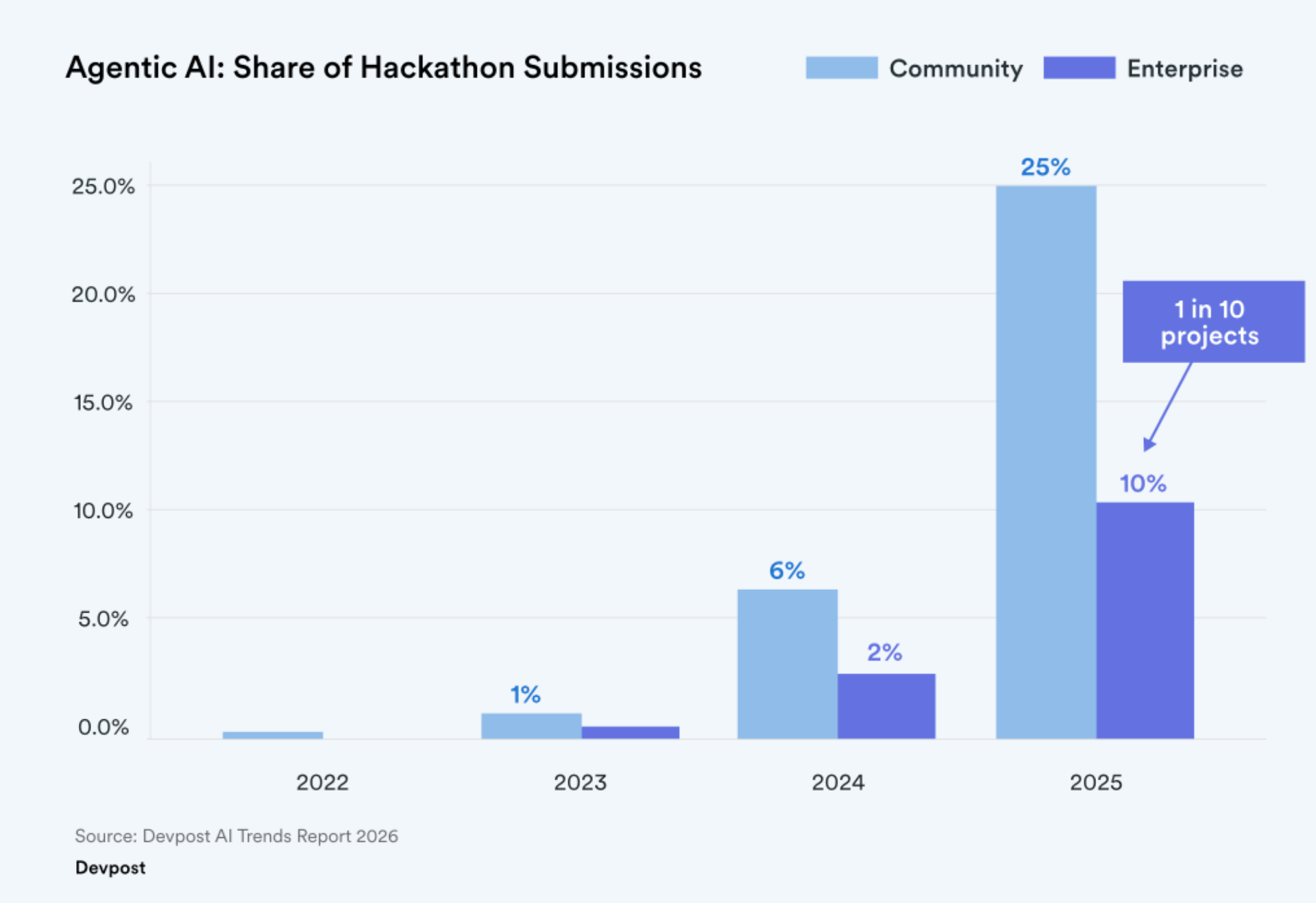
1 in 4 community hackathon submissions is now agentic. This refers to the end product—participants are submitting autonomous AI systems that can complete tasks, make decisions, and operate across multiple steps without continuous human input. Two years ago, that number was almost zero.
In enterprise, or internal hackathons, agentic submissions sit at 1 in 10. Both figures are rising, with projections putting community at 1 in 3 and enterprise at 1 in 5 by the end of 2026.
When developers have access to current tech and the structured space to explore, their projects get more ambitious.
{{callout-1}}
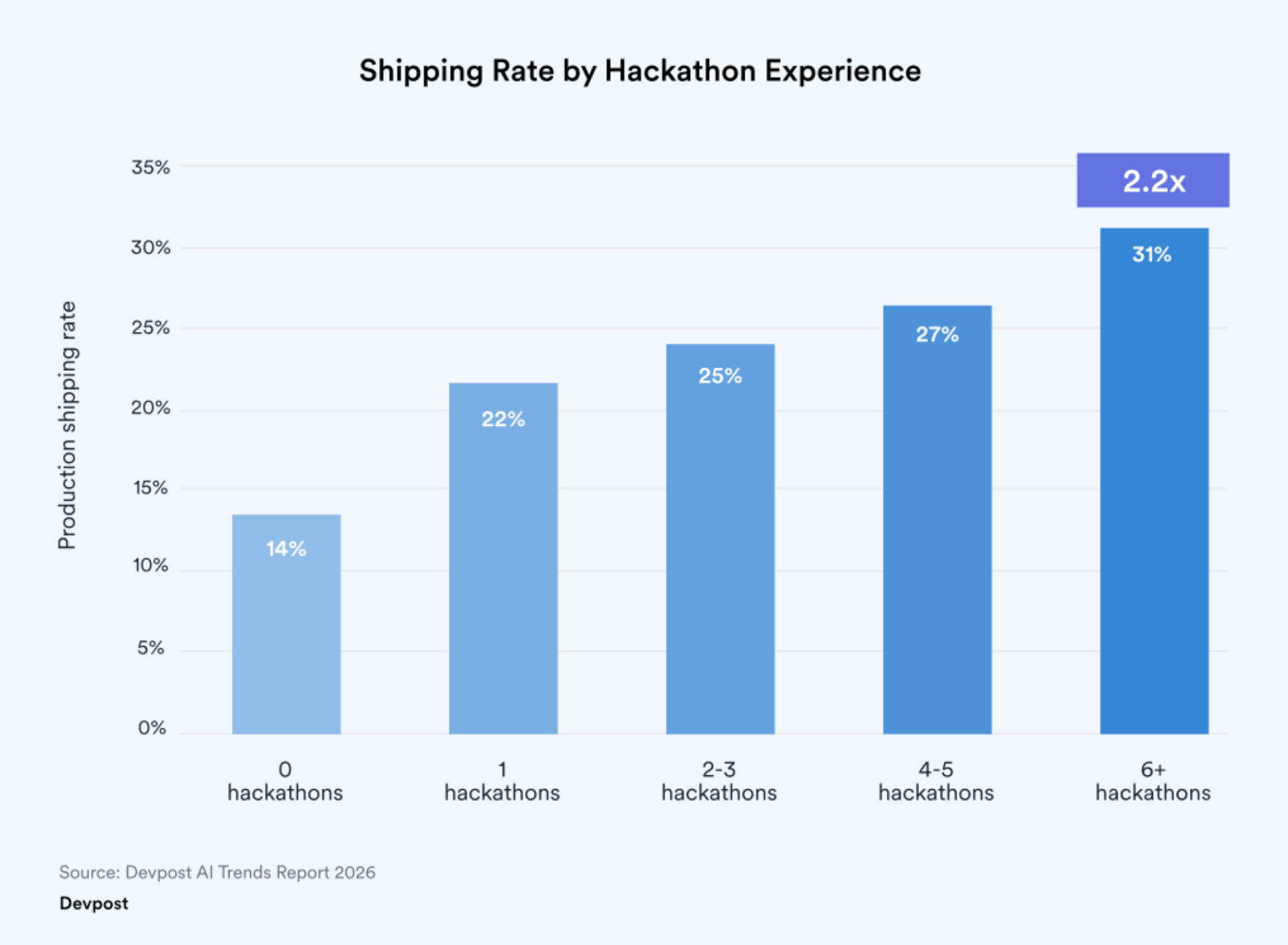
As builders participate in more hackathons, their rate of shipping projects increases, too. Developers who have participated in 6 or more hackathons ship AI projects to production at 2.2x the rate of first-timers.
Professional developers are also building faster. Between 2023 and 2025, they cut their ideation time by 34%, reduced build time from 106.5 to 89.2 hours, and shortened submission cycles by 32%. Hackathons on Devpost typically have six to eight-week submission periods, so the time spent building reflects sustained development that mirrors how real project cycles work.
For any organizer, this is the core case for scaling your hackathon program from a single event.
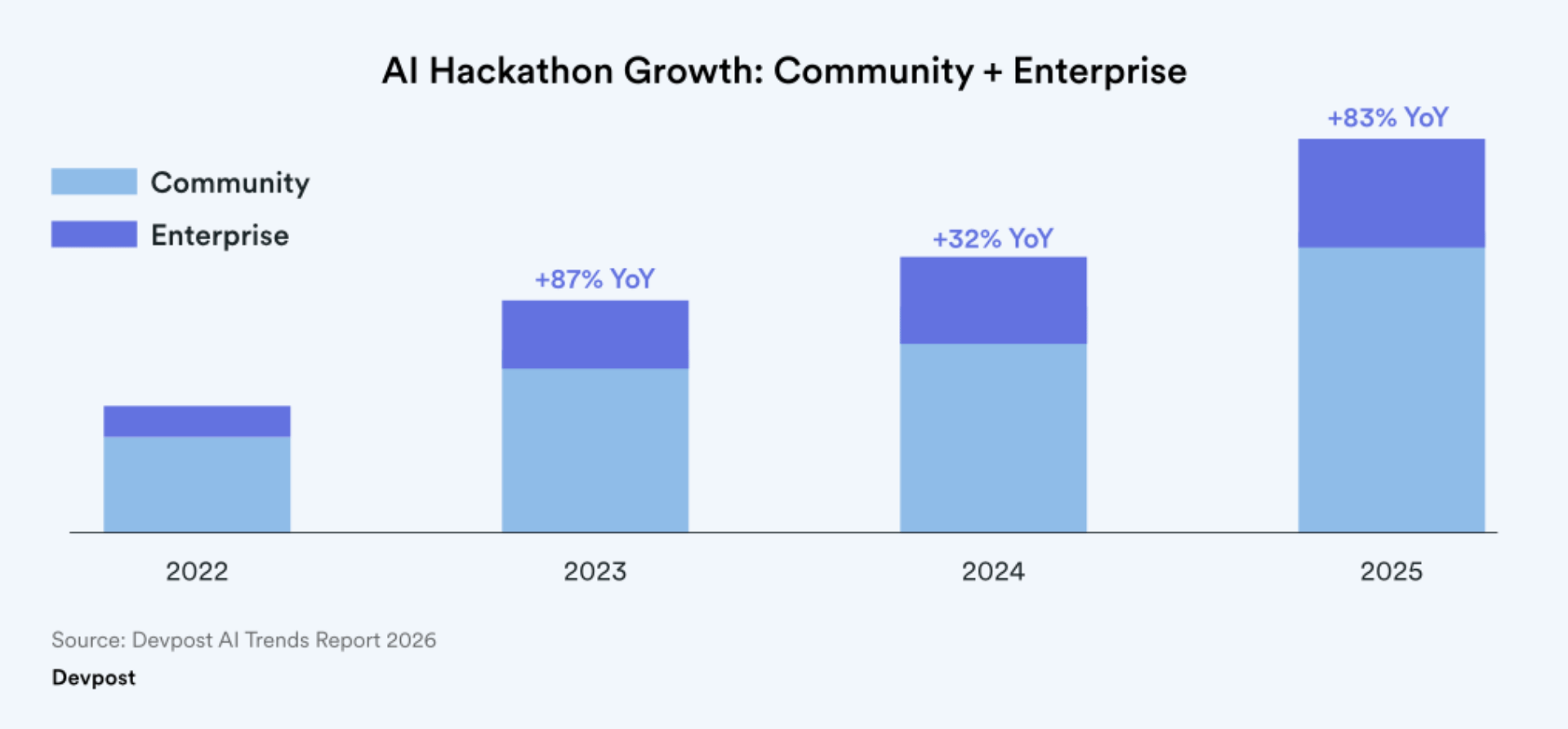
Enterprise AI hackathons grew 83% last year, and the companies that have moved past single events are running recurring programs and seeing what sustained investment produces.
Grafana Labs runs four company-wide hackathons per year. Nearly 40% of project submissions from those programs make it to the product roadmap. JLL runs internal hackathons to provide opportunities for teams to learn emerging tech and ignite innovation.
Team upskilling is a consistent theme in enterprise programs. AI capabilities are evolving fast, and internal hackathons give employees a structured way to develop hands-on AI skills alongside their regular work. Participants come away having actually built something. That hands-on experience translates into real capability on the job.
Some enterprise teams also use hackathons to give developers limited access to AI tools they can't easily experiment with in production environments. Okta's Director of Innovation Programs, Neta Retter, describes giving participants short-term access to new AI tools with fake data as a way to evaluate what to invest in before committing to expensive enterprise licenses.
"We’ll give folks very short access to new AI tools in a sandbox environment,” she said.
“Then we can decide which tools we want to buy later because enterprise licenses to these tools are expensive and risky. Whereas if you’re using the tools with fake data, you can create the value by leveraging hackathons,” said Neta Retter, Okta.
ChatGPT held 96% of the market in Q1 2023. In 2026, that number is 33%, with Gemini at 47% and Claude at 14% and climbing. The market has changed quickly, and it's still in motion.
For companies with developer tools, this shift matters. In a market this active, developers are constantly exploring and evaluating. Structured hands-on time in a hackathon with real constraints and real deliverables is one of the most effective ways to drive developer tool adoption.
On the enterprise side of things, companies that employ devs should consider how they’re making the most of AI tech internally. AI presents a genuine and significant opportunity for companies that can get their builders working with the technology effectively. Hackathons give the developers at those organizations the chance to experiment with the tech, develop AI skills, integrate new workflows, and build products and processes that actually ship.
Run a program, not just an event. The returns on recurring hackathon programs are consistent across the data. The developers who ship more and build faster are the ones who have had repeated opportunities to build.
Give developers access to tools. Whether you're an enterprise team letting employees experiment with AI, or a public organizer giving dev communities a reason to build with your tools, the mechanism is the same: real time, real tools, working on a real problem.
Understand what's getting in the way. Knowing what's slowing developers down is the most direct input for improving your program. The top blockers developers reported when building with AI are in the full AI Trends Report 2026, where the data on developer tool adoption goes deeper.
Get the full data, including the top blockers developers reported when building with AI, the complete agentic AI projections, developer tool preference shifts, and what the data shows about how to build a hackathon program that produces results.

