Participant resources
6 Benefits of submitting your hackathon project early
Here’s a look at the numerous benefits of submitting early to a hackathon.
Read more


Lucas Martinic started Polyfork halfway through the Build with Gemini XPRIZE and won $500,000. Here's how his AI agent factory works.


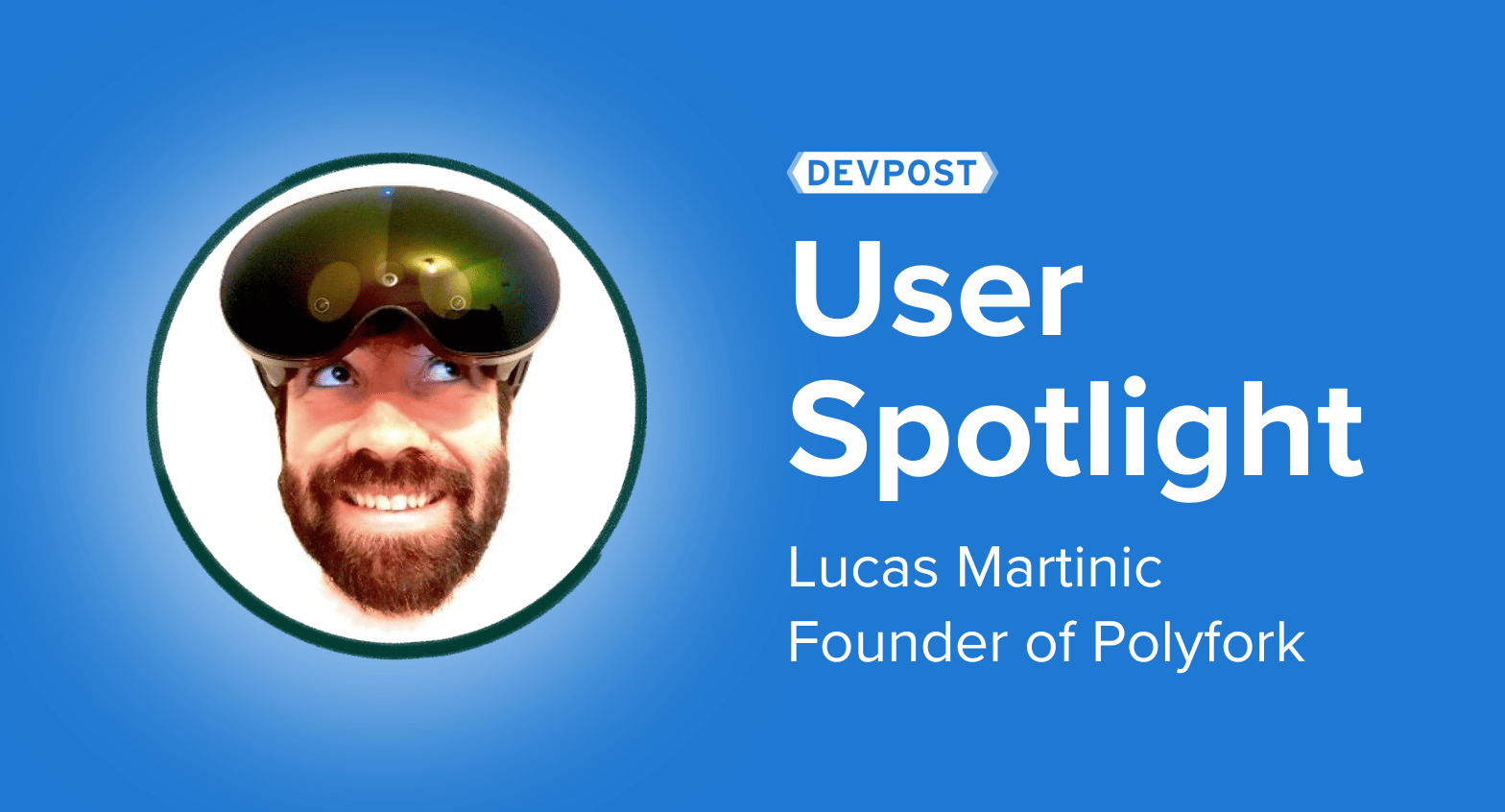
Every morning in Berlin, Lucas Martinic opens his laptop to find out what his factory built while he slept.
The factory isn't a building. It's a crew of AI agents that draft, build, test, and argue over 3D models through the night. By morning they've settled their disagreements, and Lucas decides what ships.
"It's really fun to start the day and see, oh, what did the factory build last night?" he told us.
That factory runs Polyfork, a library of 3D models you can resize, recolor, and remix before you download them. In September, Polyfork won first place and the $500,000 grand prize in the Build with Gemini XPRIZE, a 90-day competition on Devpost that asked builders to launch a real AI-powered business, with real customers and real revenue.
Lucas built it alone. And he didn't start until the competition was half over.
His story matters to anyone who has looked at a deadline and decided it was too late to start. When we asked Devpost readers what stops them from submitting, the top answer was "I run out of time." Lucas gave himself half the time and finished first.
Lucas came in about halfway through the 90 days, once he had an idea he believed in. "Sometimes I have an idea, I think it's good, and I just go for it with all my time," he said.
He built for about six weeks, around 12 hours a day. He's quick to add that it didn't feel like work. "I just want to make it work because I have it visualized in my head."
The move that mattered: he launched on Aug. 1, more than two weeks before the deadline. That left time to find out whether anyone would pay. He didn't wait long.
"There's doubt between when you launch and when you get your first sale. Luckily, that was only hours for me."
About 12 of them. By XPRIZE's count, Polyfork made $4,428 from 54 paying customers in its first month.
One thing didn't work: letting agents do the marketing. He had them make videos and auto-post them to Instagram, Threads, YouTube, and TikTok. That brought in one or two sales. What sold Polyfork was Lucas posting about it himself on LinkedIn and X.
"Marketing still needs a lot of human in the loop," he said. "It's made for humans."
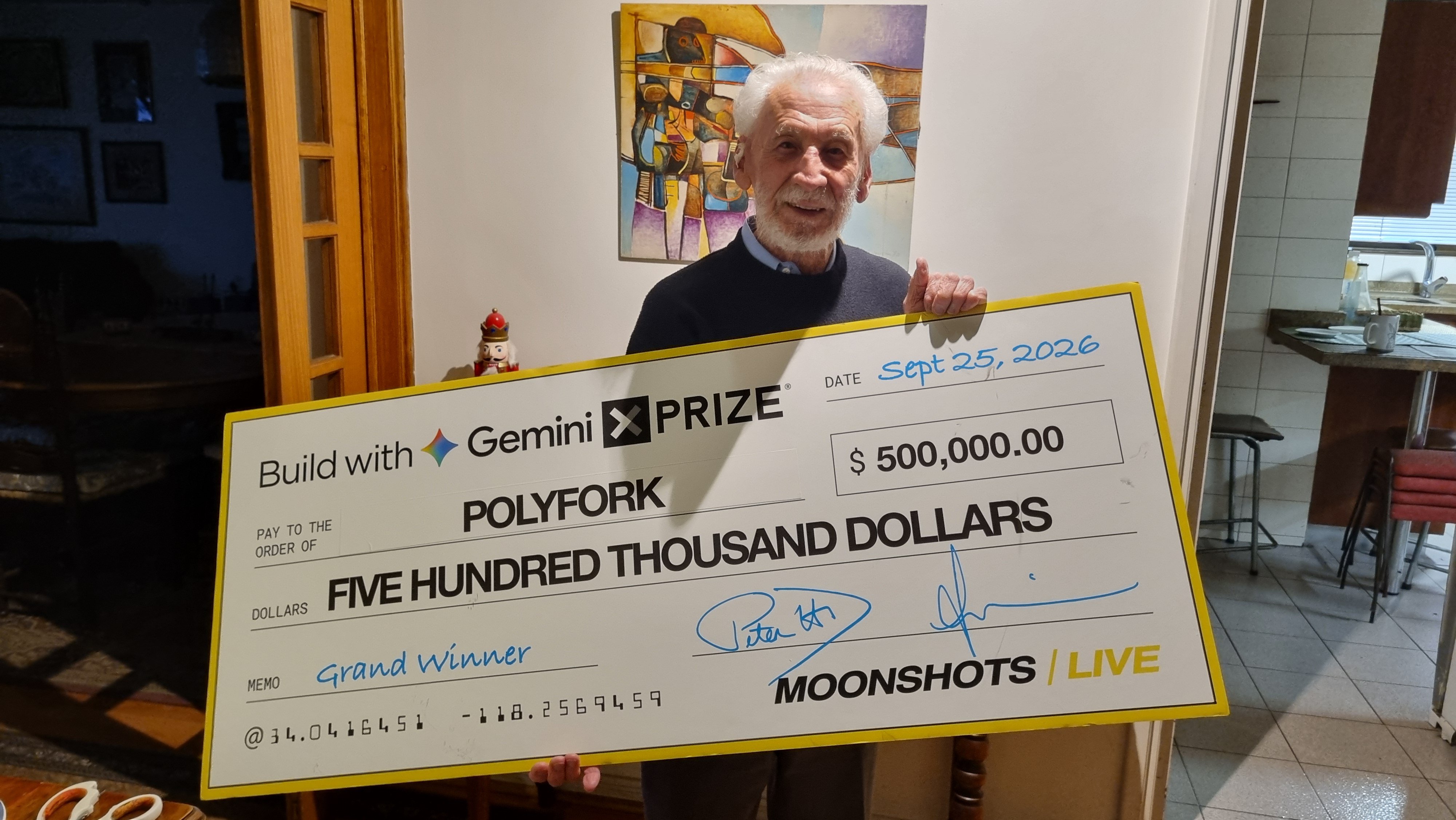
On Sept. 25, at Moonshots Live in Los Angeles, Lucas pitched against four other finalists in front of judges XPRIZE had announced in August, including Cathie Wood, Palmer Luckey, and Google's Logan Kilpatrick. Polyfork took first place and Lucas's grandfather now has the giant check on his wall.
Most hackathons ask for a working demo but the Build with Gemini XPRIZE asked for a business. Judges scored three things: whether it made real revenue from real users, how much of the business AI actually ran in production, and how much it could move its category.
That was new ground for Lucas. His day job and most of his hackathons are in XR. "This one was totally different," he said. "Build a business. It doesn't matter in what area. Real customers, real revenue."
He wasn't starting cold, though. He'd spent the year following indie hackers on X, the people who build small products fast and share their revenue in public. He'd also joined a Discord group with one rule: ship one startup a month, or you get kicked out.
AI is what makes that pace possible. Before, he said, one product took a year or two to build, and a failure cost a lot. Now the cost of trying is some time plus an AI subscription, "100, 200 bucks." You can test frameworks, hosting setups, and whole product ideas without betting everything on one.
Polyfork was about his fifth AI business that year. The first few were developer tools. (Everyone in the group started there, he said.) The one that worked came when he went back to what he knew.
"Polyfork is a 3D tool that I would use way more in my day-to-day job than anything else I built before."
For other builders, if your AI projects have started to look the same to you, this could be the fix: build where you already know the problems.
Polyfork solves a problem Lucas kept hitting in his own XR work: 3D models you can't adjust to fit your scene. Most 3D models are like a photo: what you see is what you get. Someone else already decided how tall the object is, and if you stretch it, it looks wrong.
Polyfork's models work more like a recipe. Change an ingredient and you get a new version, built fresh. Make a traffic cone taller, and Polyfork doesn't stretch it. It rebuilds it, adding an extra reflective stripe once there's room.
Models also come in kits that share the same scale and colors, so the pieces fit together. For developers: each model is code, so you can import it straight into a three.js scene like a package:
import { createAsset } from 'https://polyfork.dev/cdn/traffic-cone-247748.mjs';
scene.add(createAsset({ tallness: 0.9, facets: 16 }));
It's built for agents as much as people. There's a public API, an MCP server, and an llms.txt file, so an AI assistant can search the catalog, read a model's settings, and pull it into a scene with no human involved. At submission, 295 of its 583 models were free to import with no account, according to the project page.
Lucas writes one line describing a kit. The factory does the rest:
He uses Gemini for the creative and visual work because it's "very, very fast and very scalable." He also mixes models from different providers on purpose.
"All the models from the same provider are more likely to agree with each other. When you mix them, you have more arguments between them."
More arguments, better results. And every build writes down what it learned, so the next build reads those lessons before it starts. A fix made once applies to everything after it.
His biggest lesson, in his own write-up: ask an agent for a program, not a picture.
When we asked why he keeps joining hackathons, the prize wasn't the first thing he brought up.
A room built for building. "It's like when you go to study in a library," he said. "Everyone is studying in the same vibe. The hackathon is the same. Everyone is building." When he has a good idea, he'll build it either way. If a hackathon fits, he'd rather build it there.
People you keep. When he first moved to Berlin, hackathons were how he met people. He compares it to being in the trenches together. You spend a couple of high-pressure days side by side, and "after the battle, you're friends with these people already."
A place to find the next one. "Most of the hackathons I participate in are on Devpost," he said. When people ask where to find them, that's what he tells them. These days he's more selective and goes after bigger prizes. He still starts in the same place.
So what would he tell the readers who keep running out of time when building? He had two answers.
Don't run at 200%. "If you're working at 200% just to win, you're going to burn out in these three days," he said. "And then if you don't win, you're going to feel bad." His take: pull back a little and the result barely changes. Take the lunch break with your team (or by yourself). Keep it fun. "The outcome is going to be almost the same."
(Yes, this is the guy who put in 12-hour days on Polyfork 😆. But Polyfork was an idea he'd have built anyway, and he had weeks, not a weekend.)
Don't force the idea. Lucas doesn't enter every hackathon he sees. He keeps a few on his radar, and then decides which ones to join. "If a good idea comes, I join the hackathon. If it doesn't come, I don't."
In September 2024, an idea hit him the same day XR Hack Stockholm was starting. He was in Berlin. He bought a plane ticket that day, landed that night, and started building on day two of three. The idea became Chamaleon: Reality Editor, a mixed reality app that pulls colors from real objects so you can paint with them. It won two prizes: Meta's Best Utility and Design, and Logitech's Best Use of MR Stylus. "It was just such a good idea," he said. "I couldn't not do it."
There will always be another hackathon. The one where you already have the idea is the one you'll finish.
Lucas's path to all of this started with a game for his sisters, made out of slides.
He grew up in Chile as the only kid he knew with a Mac, a blue all-in-one iMac. His friends had PCs, and Mac games were hard to find in Chile. What the iMac did have was creative software. So he made choose-your-own-adventure stories in a slideshow app. Click one spot and you land on one slide. Click another and the story branches. Every choice changed what you got.
He started a software engineering degree and left fast. "I'm a person that likes to make things to learn," he said. "University was too slow." He spent the next six years as a full-time touring musician.
Then, in Guadalajara, Mexico, he tried virtual reality for the first time. He was hooked, and he taught himself the rest.
He moved to Berlin in 2019. A few months later, he walked into his first hackathon.
A friend had a Microsoft HoloLens, and in February 2020 the two of them signed up for the Jelbi Hackathon, run on Devpost by BVG, Berlin's public transit company. BVG wanted ideas for Jelbi, its new network of hubs that put shared bikes, scooters, and cars next to the train. The weekend had three tracks: where to put the hubs, what services to add, and how to run them.
Lucas and his friend ignored all three. They built an AR overlay for the HoloLens: scan something at a stop, and it shows you where to go and when your bus is coming.
The organizers had planned for a team like that. Next to the three tracks sat a fourth award, the "Is mir egal" award, Berlin slang for "I don't care." That's the one they won.
"We didn't care about the categories at all," he said. "We just built our own thing."
Six years later, his biggest win came through Devpost too.
Polyfork is adding more build lanes and, soon, its first hires. The factory removed the modeling work, not the judgment, so more output means more people reviewing it.
Since the win, Polyfork has also opened up. Lucas used the award funding to make most of the library free: every low-poly model, plus every model the factory builds from here on. HD models now come with a paid account. Polyfork announced on X more than 2,600 free game-ready models, with about 200 more added each week. "I'm on the way to make it more open and free so everyone can use it," Lucas told us.
As for hackathons, the next one on his radar is the Meta VR Start Developer Competition 2026, open to Meta VR Start program members until Nov. 18. It's right in his domain, and he's won it before: Inkphony, which he built with Tejas Shroff and Nadja Pirchheim, took a first-place award in the 2025 edition. It turns the space around you into instruments you can write music for.
Will he enter? If the right idea shows up before Nov. 18, he'll build it there. If it doesn't, there's always another hackathon.
Running out of time on a project? Cut it to the version you could ship this week, and ship that.
Waiting on the right idea? Keep a few open hackathons on Devpost on your radar, and jump in when one clicks.
See Polyfork on Devpost · Try Polyfork · Follow Lucas on LinkedIn and Polyfork on X.