Participant resources
Understanding hackathon submission and judging criteria: What really counts
Dive deeper into what it takes to understand a hackathon’s submission and judging criteria.
Read more


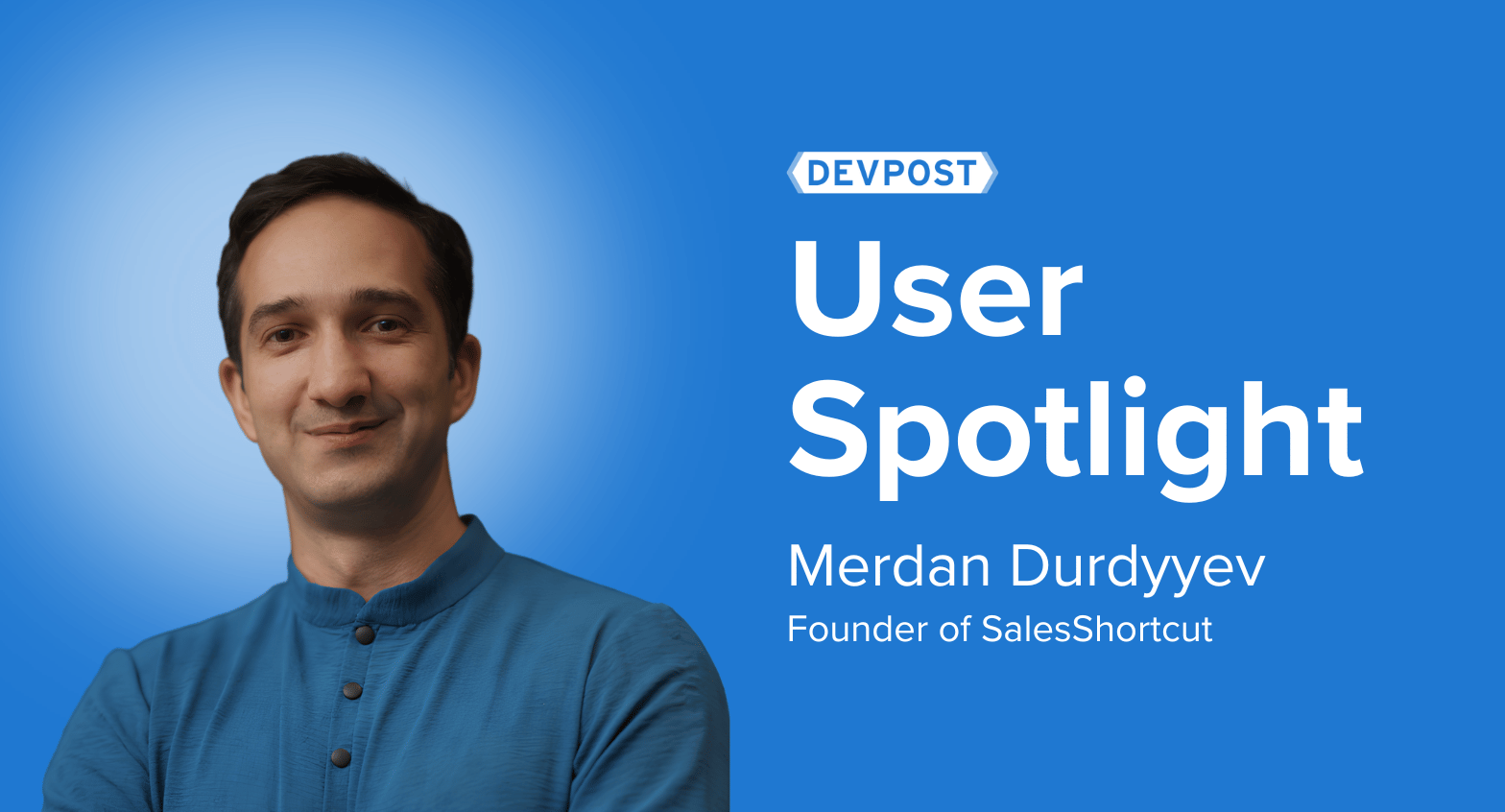
SalesShortcut won the Grand Prize at the Agent Development Kit Hackathon with Google Cloud. A year later, it’s a company with paying customers. Merdan Durdyyev shares how he got there.


Ever wondered what happens to a hackathon project after the hackathon ends?
Merdan Durdyyev and Sergazy Nurbavliyev built SalesShortcut in 16 days for the Agent Development Kit Hackathon with Google Cloud, and it won the Grand Prize out of 477 submissions. A year later, it's a company with 7 subscriptions and $1,600 a month in revenue. We asked Merdan how he got from a submission to paying customers. Here's what he told us.
Merdan's story starts further back than most. "I first touched a computer at 21," he says. "I couldn't turn it on."
Before building products, he was cleaning sewer manholes for a phone company and kept failing to get into university. The Military Institute of Turkmenistan took him in, and he learned to code in the army. Thirteen years later, he left as an Army Captain.
After the army, he kept the build train going. He ran Asman Express, a 10-minute delivery app in Turkmenistan, and his team built PostBilling, the billing system for the state postal service. New developers in his country had no books, mentors, or network, so he built that too: Turkmenistan's largest IT community.
In 2024, a Fulbright scholarship (a U.S. government program that funds international students to study here) brought him, his wife, and their three kids to Utah for a master's at Utah State University. When the Agent Development Kit Hackathon with Google Cloud opened, he was studying, working part time as a data engineer at Lightning Kite, and building AI agents on the side. (Free time was not really a thing.)
In spring 2025, Google Cloud ran a hackathon on Devpost built around its Agent Development Kit (ADK), a toolkit for building AI agents. The challenge: design teams of AI agents that work together on complex jobs. More than 10,000 people from around the world signed up. Merdan was already planning to learn ADK, so the timing worked out.
"The hackathon gave me the excuse to just put everything else to one side and do it."
The idea came from an earlier hackathon in San Francisco, where a guy told him about the sales work he was doing with his little brother. Merdan's thought: he could build that whole pipeline with agents. He opened the repo on a Friday night, June 6, 2025, at 8:28 PM and got started.
The hackathon version of SalesShortcut was basically an AI sales team. You gave it a city, and it did the rest. It found local businesses on Google Maps that didn't have a website, researched each one, and wrote a custom offer to build them one. After a fact-check, an AI voice called the owner and followed up by email. If the owner wrote back, an agent read the reply and put a meeting on the calendar.
He didn't build it alone. His teammate, Sergazy Nurbavliyev, is a data scientist (now an ML researcher at Adobe and an advisor to SalesShortcut). They split the work cleanly. Sergazy handled the data: finding the businesses and storing every lead, call, and email. Merdan built the agents and got everything deployed. Sergazy worked in his own fork and sent changes over as pull requests, and Merdan wired them in.
"That split enabled two people to ship 5 services and 34 agents in 16 days."
It wasn't all smooth. On June 19 at 11:18 PM, his commit message read: "Need to test the flow, no errors but no result." Every agent ran. Nothing crashed. And nothing came out the other end. With 34 agents passing work to each other, there was no way to see which handoff was eating the data.
So they stopped testing against the real world. Instead of calling Google Maps and BigQuery live, they fed every agent the same sample data each time, a standard testing trick. That let them walk the flow one agent at a time and see exactly where the handoff broke. Two days later: "First ever full test passed."
The part he's proudest of is the moment it all closed into one loop: type in a city, and the agents carry it all the way to a meeting on your calendar, no step skipped. And the piece that makes it safe to use on real people is a stop sign in the middle. Nothing goes out until a human says yes. Getting that right cost him an entire afternoon on June 17.
"An AI that calls real people for you has to ask first."
So how did two people pull that off in 16 days? Here's the stack behind those 34 agents built with ADK:
Along the way, the team sent fixes back to ADK too: two issues and an accepted pull request on the ADK docs.
In plain language: instead of one big AI trying to do everything, he built a team of small AIs that each do one job, plus a few that keep the team in order. Some take turns, some work side by side, and one keeps redrafting until the work is good enough. That same setup, a team of one-job agents with a manager on top, is still how SalesShortcut works today.
During the hackathon, ADK handled the plumbing Merdan would otherwise have spent all 16 days on: handing work between agents, returning tool results, pausing to wait for a human. Google Cloud covered the rest in one place, from Gemini and the Maps API to BigQuery and Cloud Run.
"Wiring that together across the various vendors would have taken longer than the hackathon itself."
A team of agents working together was exactly what the hackathon asked for. SalesShortcut took the Grand Prize, the top award of the whole hackathon: $15,000 in cash plus Google Cloud credits. Since then, 58 developers have forked the repo to build their own.
Winning could have been the end of it. Instead, Merdan showed the project to Dan Ostler, President of Lightning Kite, who offered to build it with him. They pointed it at Logan, Utah, Merdan's home town: 190 businesses with no website, 45 calls, 25 good conversations, 3 meetings, and 1 customer.
That one customer was Tristan, a window cleaner, who bought a website for $25 a month. Small number but real signal. Later, Tristan mentioned he was already paying a company $200 a month just to push his Google Business Profile to the top of search.
In other words, Tristan was paying a stranger $200 a month for one piece of the job. That's when Merdan saw the real product: one AI that does the whole job, running a business's Google profile, website, and social media for the owner. In December 2025, Tristan signed on at $175 a month, and Dan became the first investor.
The agents themselves barely changed. In Merdan's words, it was the "same agents, other side of the table."
"At the hackathon my agents hunted for businesses with no website. Today they work for those businesses."
Kept: the architecture. It's still a team of agents with one job each and a manager on top. One builds the website, one handles SEO, one runs social media and reviews, and the manager decides what to do next. The Python services still run on Cloud Run.
Dropped: the AI cold calls and the dashboard.
"Contractors do not open dashboards. They are on a ladder or pouring a driveway all day."
So SalesShortcut is turning into an agent you text. No app, no login.
What decided it: customers. Tristan's bill showed the real pain. Five new clients in one month taught the team that local businesses want real photos and real stories, not random AI posts. In May 2026, co-founder Bezirgen Shayymov joined as CTO and rebuilt the product from the ground up.
The AI calls and the dashboard were a big part of Merdan's hackathon demo, and he built them himself. Once real customers showed up, he had to cut both, because they didn't need them. That's hard to do (we all get attached to the stuff we build), but it's a big part of how his project turned into something people would pay for.
Today, SalesShortcut Inc. is a three-person company: Merdan as CEO, Bezirgen Shayymov as CTO, and Soyli Sahedova as CMO. Their customers are solo home-service contractors in Logan, like window cleaners, concrete crews, and carpet cleaners. Many of them are immigrants, like the founders.
Right now they have 7 active subscriptions and $1,600 in monthly recurring revenue, and customers stick around because they see results. Two clients have already earned back a full year's fee from jobs SalesShortcut sent their way.
Google is still at the core of it. SalesShortcut is built the way ADK taught Merdan, with small agents that each have one job and a manager agent on top, and it still runs on Cloud Run. It's also approved for the Google Business Profile APIs, so its agent can update each contractor's Google listing directly and track how it's doing every week.
Next, the team is building an agent that runs a contractor's whole online presence by text, so the owner only spends about an hour a week on it. The plan is to grow the way they started: one town at a time.
Looking back, the win gave him more than prize money.
"For an immigrant whose accent made cold calls fail, a Grand Prize from Google speaks louder than any pitch."
He put his share of the prize into the company. In his words: "Best investment I ever made."
As Merdan puts it, "Submissions close. The problem does not." His advice comes down to one step:
"After the demo, do one more thing: show it to one real person who has the problem. Not a judge. Not a friend. Someone who would pay. If they lean in, you do not have a weekend project. You have a company that started on a weekend."
And if you think you started too late:
"I touched a computer for the first time at 21. Fourteen years later Google picked my project out of 477. Start where you are."
Got a project sitting in your Devpost profile? Pick ONE person who has the problem it solves and show it to them this week.
Haven't shipped yet? Find an open hackathon on Devpost and start where you are.
See the original SalesShortcut project on Devpost · Visit SalesShortcut · Follow Merdan on LinkedIn